7.03.2006

Nobody Can Ever Take This Away From Us

I put up all the old recordings I did way back when with Roller Chair Derby for the sake of archiving them. Help yourself if you're interested.

I put a little quote on there, which - egotistically enough - is myself. I remember saying that to our drummer (a few guys held that role, but John Carpenter really was the only one I ever thought of as our drummer) one night when having a pretty nasty difference of opinion on how I was going to divvy up the night's earnings. If memory serves me correctly, I was dishing a heavy hand to the Spitvalves, a visiting band among the otherwise-local roster. That isn't important though.

Even though our songs are perhaps listened to by a dozen or so people these days - and half of them ourselves - nobody really can ever take this away from us. What we did back then, playing shows, pinching money together to record these songs, it's ours, and these mp3's are a reminder of it.

Well, nothing poignant to say, really, and certainly not related to game design, but there you have it.

12.01.2005

Next Gen Apathy
polycounts don't excite me anymore

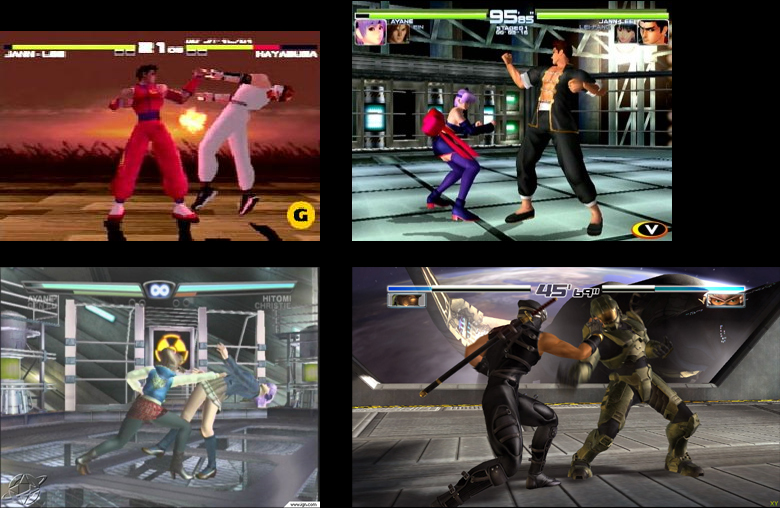
I want you to try something. In your mind's eye, I want you to picture a scene from Dead or Alive 2. Don't focus on it too hard, just call up a memory of the game if you've played it. Now, clear your mental palette and call up an image of Dead or Alive 4. If you feel like it, do the same for the other games in the franchise as well.

Next, try looking at the games side by side. Before you do, though, sit back a few feet from your monitor. Now take a look. Feel free to look at them more closely now.

If you're like me, you probably didn't see much of a difference until at least seeing the images, if not upon closer inspection. While the 360 may be a big jump for us in terms of horsepower, most of that power is still being applied to graphics, and the sorts of graphical improvements we're seeing are fairly 'geeky' shaders and the like - the sorts of things your cousin with the Bitchin' Camaro is not going to notice unless you put the games side-by-side and point them out.

I'm far from the first to cry out that graphics are no longer paramount, but I think the feeling is growing more pervasive. I was once a drooling xbox fanboy, and DoA3 has always been the game I pull out to show the system off to non-gamers. Graphics made all the difference to me; I couldn't fathom why somebody would deign to play any multi-platform game on a lesser system. Perhaps I've gotten cynical in the past four years, but this demonstration made it clear to me how much I've flip-flopped on that - as far I'm aware, King Kong's just as fun and interesting on xbox as on it's big brother 360.

Again; I'm not the first to say this, but we need to improve our games in other ways, besides pure graphics injections. There are a lot of complex, ambient enrichments, like improving physics and AI, that can benefit from hardware advances - though I'm not aware of anything revolutionary happening for those systems in this generation. An animator friend of mine mentioned motion blur as a next-gen feature he's excited about, but that seems like small potatoes to me. Talk to me when we can do in real-time what Endorphin's helping us pre-render, and I'll get excited.

I have a hard time going back to games on Saturn or Playstation, because of the graphics jump we took after that generation, but I can still boot up Crazy Taxi on my dreamcast without feeling like I'm taking a trip down memory lane.

This underscores my personal apathy towards the 360 and PS3 launches. I'm fairly certain that exclusivity is what's going to eventually drive me to purchase both of these systems.

Likewise, this also highlights why I'm so excited about Nintendo's Revolution. Though I can't can't make any predictions I'd be confident in regarding it's success, I think they're going in absolutely the right direction - at least as far as reaching out beyond the audience that they've created and nurtured. I absolutely think there's a place for established genres and control schemes in the future of gaming, and I believe the course the industry has been on will continue, but with a broader approach to a broader audience. Nintendo's helping us do that by defying convention on such a grand scale.

You're seeing a lot of commentary these days that express similar frustration with our industry. We need new control schemes! We need more innovative titles! We need alternate revenue streams! We need new distibution methods! We need more indie support! It certainly seems like we've reached a sort of plateau with our current development and business models.

It's going to be interesting to see in what ways we, as an industry, grow and thrive in the coming generation.

11.15.2005

Narrative Strategy for Aeon Flux
(with no time to spare)


Aeon Flux came out today, two weeks ahead of the film, and it's being pretty well reviewed so far. There are two reviews on gamerankings at this point; both give a 7.8

The IGN review was generally complimentary, but the reviewer interested me by choosing narrative as a point to pick on a bit. This is (probably) not undeserved, and I wanted to share a bit of insight, and do some retrospective pondering.

Coming out of Bloodrayne 2, we began working on Aeon Flux pre-production while Majesco was still inking the deal. We were a little divided between working to the film script versus the original Peter Chung animations - Not because of any internal strife, mind you, but because we weren't totally sure what we'd be allowed/encouraged to do once Mtv, Paramount, and Majesco started commenting on our work. We knew early on that we didn't have to follow the film's story arc, (a lesson learned from previous dealings with Hollywood) but we would be required to follow it's style. Vague; but enough to get started. There was, after all, no time to be lost.

We also knew that the game had to ship in the movie's release window. When that was, we did not know - we were told to expect any time after summer 2005. That gave us a development cycle of around ten months, which anyone in game development can tell you is not an ideal scenario.

Thus; the stage was set. Eight of us were directly involved in pre-production - Creative Director, Producer, Game Designer, and five of us level designers. Given the circumstances mentioned above, we came up with a bold plan of action.

As stated before, we knew that we weren't going to try and follow the movie script directly, and felt a duty to remain faithful to Chung's source material. We also knew that we would have little, if any, time to count on for re-writes, and that we were likely to cut one or two levels down the road. (again; lessons learned) For all of these reasons, we chose to design each level as a self-contained story, in the spirit of the original Chung shorts. The game was not to feature an overarching storyline whatsoever, except that the final mission would attempt to segue logically into the premise of the film. (we also planned to let the player choose in what order to play levels, though I'm not sure if this feature was cut or not)

We felt pretty proud of ourselves.

I'll make it clear at this point that I quit my post at TRI mid-cycle (when opportunity knocks, it is not always polite) and have not been involved in the project since april of 2005. I cannot speak for the team in regards to how well things turned out; a lot may have changed after my departure.

Our strategic decision came to mind after reading the IGN review. Did the reviewer just "not get it", or was our approach a mistake? My initial, gut reaction told me the latter. After some consideration, however; I realized that our approach was clever in it's own way, born out of the grim reality that comes with a ten month dev cycle and a team too ambitious to just re-release Bloodrayne 2 with a sci-fi facelift.

I'd be interested to read what more reviewers have to say about the narrative of the game, and to play the game myself! (I haven't played it in nearly six months, after all) I'm also curious to hear what others involved/interested in game narrative have to say about our approach. Was the concept a good one, even if the execution leaves something to be desired, or did we drop the ball and justify ourselves by hiding behind a (competley insane) schedule?

Vanity forbids me to post this without mentioning that Peter Chung saw an early build of our game around E3 last year and gave us his blessing. I'm very proud of that. I wonder if he feels the same way now?

Comments welcomed. =]

11.05.2005

My Love Affair in a galaxy far, far away.

My buddy Phil pointed out to me that Dillenger Escape Plan had a video featured on the On-Demand video service we both happen to subscribe to. I'm not a devoted fan of the band, but I keep a few of their songs handy - crazy material full of dissonant sounds that somehow work together. I listen to them as much out of respect as enjoyment.

Imagine my dismay, then, when I watch the video - devoid of all the elements that attracted me to the band in the previous years of casual listening.

Again - not a huge fan, but this dissapointed me, and I discovered that the vocalist was new, and the band was moving in some sort of new direction. The whole experience annoyed me - it seemed they were just capitalizing on the reputation of the previous band. The sound was so completely different, I couldn't understand how it was still the same group, really.

There are bands out there, like Bad Religion, that you can count on for a certain kind of experience. Sure, I may take a single of Generator over the entire New America album, but either way I'm in for a Bad Religion record.

But I'm not writing to vocalize some music snobbery.

If you've been following the gaming headlines, you'll have noticed the Star Wars Galaxies revamp. I'm one of those oddities that's been off and on with SWG since just after launch. I admire it's sheer amibion to the extent that I can easily ignore the generally buggy state of the game. Where other MMORPG's can't hold my interest for more than a month or two, Galaxies is like a favorite T-Shirt. No matter how stained or torn, I always end up wearing it again.

The game's no stranger to controversy. SOE's made sweeping changes before now, causing huge outcry among subscribers, and has suffered a lot of badmouthing from the hardcore audience. All the while I've quietly applauded their boldness. This revamp, however; it has me worried. There's an overwhelming sense of sadness, not outrage, among other long-term players when I log in this week. We've only got two weeks left with the game we love - the game we've loved for over two years.

From what I've read, and a very brief opportunity to play on the test server - the game's fundamentally changed. Why would SOE do this? One popular theory within the community dismisses this as a dumbing-down for upcoming console ports. But that's just a rumour, right? Why alienate your (albeit dwarfed by WoW) consumer base to appeal to a different demographic that you might not even be able to grab?

Why not just release a new SKU?

And this is what makes me wonder: if Dillenger Escape Plan wants to keep their name despite adopting a totally different sound, why wouldn't Sony/Lucasarts want to keep the SWG name (which is inarguably visible, even if the repuation is questionable) despite changing the core design and mechanics of the game?

In both scenarios, you're alienating the "faithful", but you stand to gain a whole new audience, and let's face it - of those faithful, only a portion will actually leave. Most will try the new sound/gameplay if out of curiosity alone, and many more will stay.

Just a thought and a theory, I've no idea how close to or far from the mark I am with it. But the fact remains:

I only have two weeks left with the game I've loved for two years. The name may not change, but my game will be irrevocably changed, and that's made me more sad than I would have expected it to.

11.01.2005

Bloodrayne - Feminine Idealist?

This morning, I was reading up on an unlikely subject: feminism. The Escapist's "women in gaming" issue came out this morning, and I had scarcely started reading, when I ended up, through a chain of blogs, wikipedia, and googling, reading up on "Raunch Feminism".

The concept, detailed in this book basically revolves around the idea that (some) modern women embrace sexuality as an empowering factor in the battle for gender equality. Author Ariel Levy uses the term 'Female Chauvenist Pigs' to describe such women. Most of the reading I did looked upon Raunch Feminism negatively - mostly boiling it down to a "if you can't beat 'em, join 'em." strategy, in which women might fare somewhat better by adopting stereotypically male attitudes towards sex, but still ultimately live in a man's world, and are disadvantaged by their womanhood.

This is all somewhat troubling to me. I grew up with an older sister and stay-at-home (mostly) mother. My dad was never violent and didn't objectify women. I considered myself a pretty englightened male. I remember publicly admonishing a friend for cat-calling girls in the mall as a pre-teen. Imagine my quandry, then, when I suddenly was making those same cat-calls, if only internally, a few years later.

This sort of struggle is described pretty well by Kevin Smith in the liner notes of Chasing Amy - As a modern, enlightened male, you think that you understand women, and are above the banal tendencies of your gender, but ultimately you're wearing blinders; You're a heterosexual male, and whether it's genetics or social conditioning, there's a drooling, insecure sex-monger living in your subconscious.

So rewind a bit. I'm reading up on this idea of Raunch Feminism, and it dawns on me, that Bloodrayne is a FCP. And suddenly I'm dealing with a similar dilemma. You see, while working on Bloodrayne 2, I was pretty aware that Rayne fit the profile that Lara Croft helped build. She's got impossible dimensions, a ludicrous wardrobe, and oozes binary sexuality. It's telling that when we received body scans taken from Charlize Theron for Aeon Flux, she looked frumpy next to our beloved Agent Rayne. Charlize Theron is, after all, generally regarded as pretty attractive, and could easily be lumped into the "unrealistic standard of beauty" category.

While working on BR2, I coped with the moral gray area of Rayne's sex image with this thinking - she's a figure of empowerment. This sentiment was echoed on occasion by female fans of Rayne, whether posting on a web forum, or commenting on a rayne cosplay outfit. I bought into that, too. Here's a powerful, confident, and above all female protaganist. Rayne's a regular role model, right? Well, no; but she is a metaphorical image of feminine power.

This is the thinking that kept me comfortable with the tongue-in-cheek humour and presentation of BR2. And to be honest, It's thinking that carried over from my general (if somewhat unrealistic) opinion of female sexuality in life: Women and men should be on sexually even ground. Neither should be criticized for enjoying sexuality, or having some disdain for it.

However; just as my pubescent mind started fantasizing about underwear ad vixens turned my youthful enlightenment upside-down, so did this notion of Raunch Feminism shake the previously-solid moral ground I stood on with Bloodrayne as an empowering figure for women.

I guess the pleasant thing about this being a blog is that I don't need to reach a conclusion - it's enough to ponder this aloud. I'm not suddenly ashamed of Rayne and having worked on BR2, but it does cast a new light on previously "safe" thinking about how we portray females in games. Beyond Good and Evil's Jade is a commendable step in the right direction, but I'm not convinced Rayne's a step in the wrong one. What do you think?